Showing posts with label High School. Show all posts

Thursday, December 10, 2015

Arthur Dunn

Paris Street, Rainy Day by Gustave Caillebotte

Names have been changed for privacy.

September 2011. My very first day of tenth grade. I'm young and new, and the way I clutch a class schedule in my hand reminds me of the intense grip people usually reserve for grabbing hold of ropes thrown down from rescue helicopters. Honestly, the schedule feels like my rope, though whether it leads to safety or danger I don’t know. Walking through the hallways, feeling increasingly diminutive compared to everyone around me, I feel inclined toward the latter.

It isn’t helped by the fact that I’m deep in my awkward stage. I put equally minimal effort into showering and fashion, wearing the same clothes most every day of the week. Pro tip to my lazier friends: you can get away with wearing the same clothes everyday...if it’s the right kind of clothing. North Face jacket plus jeans? Solid. My linty, knee-length, zip-up coat that seemed to act as Redmond High School’s duster, based solely on the sheer amount of detritus it collected? Hell no. Add to this my unbrushed hair, windswept by fierce breezes on my mile-long walk to school, chapped lips (I was opposed to chapstick on principle, since I thought it counted as makeup, which was for people of ill repute and my sister), and glasses, always smudged and falling ever so slightly down the bridge of my nose. 

Point is, thirteen-year-old Adora Svitak was not exactly a studmuffin.

But people are polite at RHS, so no one says a word. 

My first class is AP Art History. It's usually reserved for juniors and seniors only, so I'm not only young age-wise, but grade-wise, compared to almost everyone else in the class. When I walk in--late--twenty pairs of eyes sweep toward me with inscrutable expressions. I quickly stumble to the closest possible chair.

“You’ll need to come with me, we’re checking out textbooks,” the teacher, Ms. C, says kindly. I follow her quickly out through the hall and down a staircase until we get to the long line for checking out textbooks. Everyone else has their school ID out and I realize with a sinking feeling that mine is languishing in a dark corner of my backpack, all the way back in the AP Art History classroom. 

“I’m so sorry, I forgot my ID!” I blurt out quickly, and run back up the stairs. It takes me a couple minutes to retrace my steps and find the classroom, and when I walk in I get some odd glances before people look away. There’s no mirror for me to check if I’m blushing, but my cheeks feel warm as I fumble around in my backpack for my ID. It’s only the first day and yet I’m already late, and I—

“Forgot school ID?” one guy asks jovially. He sets his backpack and art history textbook down on the desk with a thump. I’m crouched on the ground by my backpack so I have to almost crane my neck up to see his face; he’s really really tall--6’1” at least, maybe 6’2”. He has a rumpled shock of mousy brown hair and rectangle glasses. In a class that seems to pull ethnically from every continent but Europe, his whiteness stands out. He’s really white is actually my first thought about him.

“Yeah,” I murmur, and he cracks me a smile. Saying "suddenly, the day doesn't feel nearly as bad" seems trite, like a paper-mache sun suddenly wheeling out from behind clouds on a Saturday morning PBS Kids show. But it's also true.

The whole class, I sit silently in a chair next to Tall White Guy, looking around and trying to understand the dynamics of the room. I feel as if everyone knows each other already; I’m the only person not sitting with people I’m intimately acquainted with. Tall White Guy is the class clown, interjecting with jokes that make some of the girls in the class shake their head and sigh in mock frustration as Ms. C looks on benevolently, mildly entertained. 

I don’t remember when I find out his name is Arthur, but I remember savoring it the first time I hear it. Arthur, I repeated in my head, ArthurArthurArthurArthurArthur until the syllables blend together into a meditative murmur like the gentle hum of a white noise machine. It takes a month for that gentle hum to speed up, into the rapid pulse I get when I slide into my chair next to him, when he makes a side comment to me during class, when he says some parting words--probably just “have a good weekend”--before we go our separate ways out the classroom door.

I am thirteen, and I call this love.

I write angsty entries in my journal trying to disown my feelings, applying a rational lens to the whole situation: I’m thirteen going on fourteen, he’s seventeen going on eighteen. I’m a sophomore, he’s a senior. We only talk in class; we have practically no mutual friends, no overlapping interests. He doesn’t even like art history. I’m a devout Democrat with ‘08 Hillary Clinton stickers on my laptop, and he’s a libertarian who jokingly runs a half-assed “campaign” (consisting of telling fellow seniors about it) as a write-in candidate to oppose Redmond’s mayor in the elections. I’m so infatuated that one night after I’ve pretended to go to bed I sneak into my parents’ room to steal their incompletely filled out mail-in ballots, quietly crouching on the hardwood floor to slip the ballots out and surreptitiously write in his name. I chicken out at the last minute and slink out with a profound feeling of disappointment in myself.

I see him the next day and think about saying, “I almost fraudulently voted for you,” but I don’t even open my mouth.

I have a tortured relationship with the idea of having a crush itself, knowing that it’s fruitless, only causing me the pain of feeling my heart rate accelerate and my face to dissolve into nervous giggles and easy smiles for his bad jokes, but at the same time it’s my first time feeling something this intense, and my infatuation for him is half infatuation for feeling an emotion that makes me feel so tugged, desperate, alive. 

I call down curses on my unfashionable wardrobe because of sitting next to him; I want to look pretty, but I know that he will only ever see me as a kid, the days that he sees me at all. The days when he acknowledges me are my happiest. One day I forget to eat breakfast before coming to school, so my stomach starts rumbling loudly in the middle of class. At least I think it’s loud; it’s loud enough that Arthur turns to me, raises one eyebrow (sending shockwaves through my midsection incomparable to the contortions of my impatient stomach), and scribbles on the corner of his notebook, “Someone’s hungry.” I scrawl back with joking indignation, “I DIDN’T HAVE BREAKFAST OK.” Internally, it feels like a victory. (If he’s paying attention to the noises your stomach makes, he’s basically bae, right?)

I find myself skipping in the hallways on my way to class. I get a strange little smile playing at the corners of my lips when I think about him. He turns eighteen. I feel increasing pangs of loss, a strange sense that he is retreating further away from me. I turn fourteen. I buy some new clothes. I shower a little more often. A square-jawed guy in Biology tells me that my new dress looks pretty on me and I’m shocked, because no boy has ever complimented me on my appearance before. 

My crush on Arthur continues, unwaveringly.

The day of our AP Art History final, he tells me that he’s dropping the class second semester. 

I cry for three days.

I cry into journal pages. A pillow. I punch my mattress and the Caillebotte painting on the hard cover of the 1000-page art history textbook. I go to bed early and let my tears roll down my cheeks. I kick off my sheets and run my feet along the cold wall, the bumps and valleys of the uneven paint job like the wrinkles and calluses of a harder, more unforgiving skin. I go from hope that maybe he’ll decide to stick with the class, to fear of the certainty that we will never talk any more now that our one excuse for interaction is gone, to sadness at what will never be, to a monotonous sort of acceptance: I will have to get over this boy. 

True to expectations, my worst fears come true. We don’t really talk; we don’t have a reason to. Shorn of the excuse of “what grade did you get on the last APAH test?” or “what are you writing your paper about?” I don’t have a reason to message him on Facebook. I think of him, often, much more often than I’d like to admit. I look with no small amount of jealousy at his pictures with the statuesque black-haired girl he asks to prom. But I don’t cry into pillows. 

Some months later, after he's long graduated and we're deep into the summer before my junior year, someone I know starts a ranting Facebook thread about abortion. Against my better judgment, I get involved. I’m overwhelmed by a barrage of comment after comment and then, out of nowhere, a notification: “Arthur Dunn has commented.” A single line, telling the person I’m sparring with to “shut up. Adora’s right.” My knight in shining armor, I thought with a wry smile (and an appreciation for the irony of that thought, coming from a feminist). 

The smile that comes to my face that day almost makes up for the fact that when I search his name on Facebook two years later on a whim I realize we’re no longer Facebook friends--at some point in time, he must have made a new account, or simply defriended me. I'm not sure why, but somehow, it doesn’t bother me too much. I like to keep him in my mind as that teenager making crude jokes in APAH next to a girl his polar opposite, small and shy and eternally grateful to him for cracking an easy smile on what felt like the first day of my adolescent life.

Friday, November 21, 2014

on not being a popular kid in high school


I guess I achieved a certain measure of notoriety by the time I was a senior in high school, the kind that comes from whispers about "the little genius" in AP Lang (whispers I never heard directly), "the child prodigy," "the published author," "the girl with the Wikipedia page." This was cute, flattering, and constantly surprising.

But notoriety is different from popularity.

Someone might have heard of me, sure, but that was different from the kind of all-consuming desire to be with me, to be me, that shadowed the popular kids.

In tenth grade I was a shy fourteen-year-old, the kind of person who sat back in my chair and watched events I didn't fully understand. But I quickly realized who was "popular." They were carefree, rich, and beautiful. They had cars which they talked nonchalantly about crashing, and cabins at Steven's Pass or Whistler. I wasn't old enough to drive. I'd never been skiing. The popular kids all seemed to be athletes, too--beautiful lithe cheerleaders, dance team girls, tall volleyball or soccer players, and a whole lot of football and track and cross country. I didn't have a team or a club that felt particularly like home; it would be another year before RHS Speech and Debate formed for real.

Because of that lack of a cohesive group, the struggle that epitomized high school stress for me was the task of finding who to sit with at lunch. In the hallway leading from the classrooms to the cafeteria, illuminated by sunlight flooding in through floor-to-ceiling windows, were wooden benches. They lined the walls, gleaming rosily. They were always packed with people. The cafeteria itself was a zoo. Both the benches and the cafeteria tables seemed reserved for that separate class of the species: people who knew people. Oh, sure, I knew people, but I wasn't confident enough to feel like I could barge into their tightly-linked circles. My sister and her orchestra friends sat on one of those wooden benches in the hallway. We said hi, tersely, once. I didn't expect to be able to rely on her for an entry into high school social life in any way other than being introduced sometimes as "Adri's little sister."

My main point is this: much as I hate to admit it, and probably tried to forget it, I know what it's like to look around furtively for an empty table, somewhere in a corner you can sit with a laptop and some food to pretend like you're eating alone by choice. (Hint: I'm not.) I know what it's like to make a last-ditch effort to bond with two of your older sister's friends just so you have some friendly people to sit with (holla, first day of junior year). I know what it's like to sit in the emptiest of empty bathrooms with your plastic sandwich container and a sandwich you suddenly don't feel like eating that much anymore because you don't want anyone you know to see you eating by yourself. I know what it's like to feel unwanted because it takes your big sister's intervention to get you a homecoming group (sophomore year!) And oh, the most painful--I know what it's like to hear one of the boys in that homecoming group tell your sister afterwards, "Adora kind of dances like a spaz."

It does get better--so much better. In a sort of exquisite karmic retribution, the boy of the spaz comment asked me to homecoming in junior year. And at lunch I started having philosophical conversations with a classmate from my AP Psych class, debates on cynicism and idealism, and alternating dirty jokes and heart-to-hearts with my best friends. I looked around a cafeteria of hundreds of people and realized that I could find a friend at almost any table I wanted. It was the kind of thing I'd only dreamed of as that shy fourteen-year-old of sophomore year.

There's a New York Magazine article entitled Why You Never Truly Leave High School, a (grim for some) piece on the disproportionate influence of your late adolescence in shaping the rest of your life. "Our self-image from those years...is especially adhesive," the article states. Maybe that's why I revert a lot to that shy fourteen-year-old I once was, feeling like I'm just tagging along with the big sister who didn't want the nerd kid sister around to cramp her style. Just tagging along with the boy who never really liked me that way. Just tagging along with the popular kids who find something entertaining or philanthropic or astute about being kind to the petite girl with half-framed glasses and big vocabulary, whose worksheet answers were always available for copying in the madcap minute before the bell.

When I think of my true self, sans all the impurities that come with time and the experiences that mean little more than X's on a checklist, I think of a fourteen-year-old girl who's never been kissed, still lights up with the joy of the unexpected when someone calls her beautiful, acts like everyone's kid sister, tells two boys she likes them with inelegant apology-and-pathos-filled letters, loves hard and runs fast. I think of a seventeen-year-old girl who will always feel grateful for the invite to the party and the seat at the table, and tries to pay those forward too. Sometimes it's those moments of struggle we try to forget that enable us to rescue the reincarnations of our past selves, as their eyes scan crowded cafeterias, looking as delicate and vulnerable as we once were--

in some ways, as we will all always be.

Thursday, July 18, 2013

I got a 520 on math on the SAT!


This is the kind of confession which is so good to get out you just have to say it in one breath--IGOTFIVETWENTYONMATHONTHESAT. And just like that, a weight is lifted. Okay, 520 isn't terrible. (I have friends who would read this and shake their heads right now saying, "Yes, Adora, yes it is." I have friends who have done that, in so many winces or raised eyebrows or sympathetic displays of lip-biting if not in words.) Well, it could've been worse! 400. Or 300. 520 is, anyway, 20 points lower than what I got the first time I took the test, and many hundreds lower than what the majority of my friends got their first time. For the record, I also took Algebra II as a junior and haven't done an AP science! The latter revelation prompted a family friend to sigh sympathetically, "Ohhh honey." I got F's on some French tests and a B overall that year.

In three years of high school, I have never gotten all A's.

As the modern-day prophet Billy Mays said, "But wait! There's more!"

When I sing, my sister, gifted with perfect pitch, asks me to "please stop." (Three cheers for not singing on key! Three cheers for not knowing what the key is!) My ability to serve successfully in badminton or tennis is sporadic at best. I have never whistled, and snapped successfully once in my life. But this is all extracurricular. Let's just reemphasize--in summary, I fail, a lot, on academic things that most of my friends don't fail on!

I say all this because of two things: comments like "oh my god you're so smart Adora" and the fact that this is the season of "WOO LOOK AT ME I GOT 800's AND 5's" for so many people.

To address the first: I feel like an impostor when people say "you're so smart" with absolutely no freaking idea how insecure I can get, feeling the need to uphold the sustainability of that compliment. I've often wondered (no joke here) if anyone would like me if they realized just how inept I am at some things.

To address the second thing: if you got a good score, congratulations!! I mean that, without resentment. I got 5's on the APs I took this year (Psych, Comp Gov, US Gov, and AP Lang, so playing to my strengths a bit...) 800 on reading and 780 on writing on the SAT! But that matters as little as my 520 and sucky transcript. I'd be a hypocrite if I picked and chose. We're defined by our good numbers as little as by our bad ones.

Sure, this 520 is probably etched into my mind the same way runners know their marathon times. It's a part of me. But it's a tiny part of me, because hopefully in my fifteen years I've learned at least that I should live a life complete enough (even as the work in progress that it is) that I have cooler failures to dwell on and better successes to treasure than 520s or 5s. Some of the smartest people I know got terrible SAT scores. Even as I get incredibly stressed out, like all soon-to-be high school seniors at this time of year, I have to remember: tests are taken, scores are given, acceptances are mailed, and life goes on!

When I was younger, speaking at the Entertainment Gathering conference in Monterey, CA, I delivered a talk about education, testing, and creativity--the kind you probably hear a lot, nowadays. Afterwards, the author Amy Tan, of Joy Luck Club fame, walked up to me. I died a little bit from fangirling. This was AMY TAN, after all, AMY TAN with her little-Chinese-lady haircut, dark red lipstick, and intimidatingly large handbag. She said that my speech had resonated with her. (Swoon.) And then she added, "I got a terrible score on my SAT!"

I could turn this into a blog post about testing culture and underlying issues in education or the like, but what I'm really trying to say is this: a lot of you have secret failures. Maybe not things like my 520, but the kinds of things you switch the topic deftly to avoid or live in dread of anyone but your closest friends knowing. You're not alone. You never have been. It gets aggravating, scrolling through your Facebook newsfeed and seeing pictures of beautiful people with their perfect scores and happy lives--the lithe runners taking all APs, the social butterflies on dance team who win medals in speech and debate, the math kids who got into Stanford and Harvard AND landed hot prom dates--but none of us have it all figured out. I have incredibly accomplished contemporaries who consistently make me feel like an underachiever, but their struggles also helped me realize that every win has its flipside.

In the end, if I love you, I love you no matter what your resume says or what you got on the SAT or how fast you run a mile or how well you write a story or any number of things at which it is entirely possible to fail at--in fact, I love you knowing those failures.

Is it too much to ask for the same?

Friday, October 12, 2012

smells like school spirit


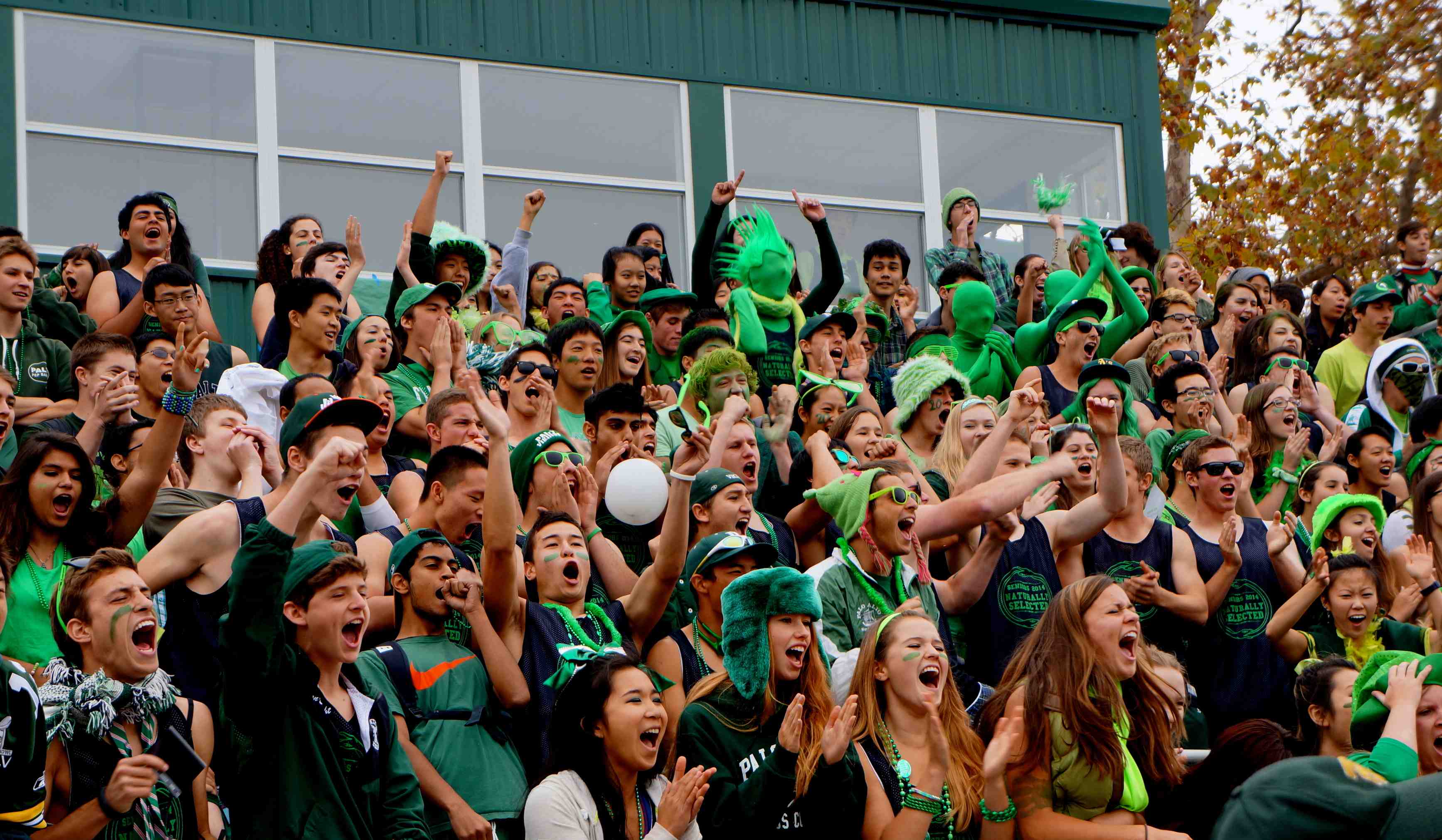
It's that time of year again, for school colors to come out, pompoms to wave, dress-up days, skits...a.k.a., the decadent pageantry during Homecoming Spirit Week. It occurred to me today that school spirit isn't all that different from patriotism. We have yells and chants, rousing music, we dress up in our school colors like people wear the flag on the 4th. And like patriotism, it's something almost everyone at least pretends to have. But I wonder if, like with patriotism, there's questioning underneath.

Because the thing is, at some point you realize that you ended up in your country not because of any awesome membership in the elect chosen to reside there, not because of some predestined fate, not because of anything that makes you uniquely American or Chinese or South African or what have you, but because of luck--because of accident of birth. And luck is something that is very difficult to be proud of.

To me, it makes little sense to have pride in such accidental membership. It justifies pride based not on the actions that should evoke it but rather because self-preservation dictates that you support your own group. Is this to say that we should disavow our allegiances because of what petty cause we have for them? Not at all.

Just, instead of rah-rah'ing for our mascot or our school's name or (in the case of patriotism) our country, we should celebrate ideals. And if in the process we find that our ideals may be more universal than our school spirit cheers or our patriotic sentiments, that's a good thing. (Guess what, it's easier to get someone to agree with "freedom, justice, and equality" than "I love America!") So why be divisive when we can unite around the things that really matter? I don't know about you, but I really care more about what we stand for than our name, our colors, or (sorry!) whether our football team won at the HC game tonight.

I think we should be proud of our schools. But I think we should have better reasons than, "because I go there." I'm proud because the amazing friends and classmates who performed at the Homecoming assembly today had creativity and drive. The folks who created clubs and rallied members to raise awareness and fundraise today inspire with their leadership and dedication. These kinds of strengths provide ideals we should celebrate.

Sure, it's hard to use face paint and pompoms to cheer on something as abstract as an ideal; but if we hope to give a glimpse of who we truly are, whether as the people of a nation or the students of a school, we will always have to go far deeper than a name.

Friday, May 20, 2011

Prom--Or, an American Tradition Gone Awry

The other day my family went looking for prom dresses for my sister. The first place we stopped was an expensive boutique with thousands of dresses. As I was about to step inside, Adrianna remarked casually,


“This place is really crowded with dresses.”

“What do you mean?” I asked, assuming she meant densely packed on hangers, or maybe not much aisle space.

“You’ll see.”

As it turned out, the store was a claustrophobe’s nightmare—a thin bit of waddling space alongside giant round racks of dresses zipped up in plastic garment bags, every color and style imaginable. By the time we walked out (no dress in hand), it felt like Adrianna had tried every single one of them.

She finally found her dream dress in a less specialized department store (where the dresses also cost half as much). The emphasis was on finding something that would be long enough to also wear at a piano recital.

What’s funny about my sister going prom dress shopping with the rest of my family in tow is that my parents were never that big on prom. More specifically, my dad didn’t go to his because he wasn’t into his high school social scene (or, as my sister translates it, he was a social outcast), and my mom grew up in ‘70s Communist China, where high school dance opportunities were pretty nonexistent.

The American tradition of high school prom, however, seems to have found a believer in my older sister—along with what seems like every American news organization. World News with Diane Sawyer on ABC broadcast not one, but two prom stories—the first to congratulate all the brave souls asking their significant others to go to prom with them, the second as a follow-up story on a boy who was suspended for trespassing on school property to post giant cardboard letters on the side of the school asking his girlfriend to go to prom with him. He’s now become a celebrity, having appeared on Today, Jimmy Kimmel, and others.

As a writer, I get it. Prom has all the elements of a popular story. It reeks of all-Americanness, tension, drama. It has romance. Pretty dresses. Dancing. Limos. High school. Coming of age. But couldn’t we get all that (maybe minus dancing, pretty dresses, and limos) with something that didn’t cost schools tens of thousands of dollars, students valuable hours in fundraising, working-class families worry over how they could afford dress and tuxedo shopping? Maybe an awards ceremony or gala to honor the unique in-school and extracurricular accomplishments of seniors? If you wanted, you could still dress up, invite a guest or two, roll out a red carpet, have music, call it prom...but you would be congratulating and evaluating people based on what they’ve done for others, not just how they’re dressed or who they’re going with.

The current concept of prom just seems so empty. Teenagers get dressed up to go to a dance at a fancy location. It encourages social inclusion or exclusion based on your ability or inability to snag a date. I feel like schools shouldn’t be taking a role in supporting dating this way—even for seniors. And it starts way earlier. People often start by going to their junior high dances in seventh grade, maybe followed by a formal dance (my sister’s was on a dinner boat in Seattle) in ninth, homecoming every year through high school, and of course, the jewel in the crown, prom in senior year. I mention this to people I’ve met in Europe—this system of dances and social events—and I haven’t heard of any equivalent.

So how did the prom come about? According to this interesting article from Mental Floss, the prom actually originated in the 1800s as an effort to teach etiquette and good manners to college students. It migrated to high school students with the same goal. Mental Floss described it this way: “the senior class, dressed in their “Sunday best,” gathered in the gym for tea and light refreshments, socializing and dancing under crepe paper streamers and the watchful eyes of chaperones.” It only started migrating to fancy locations in the 1950s, and in the 1980s, the prom became the giant deal that it is today, with students voting on where they want their prom to be...sometimes two years in advance. Paying hundreds—or thousands—of dollars for dresses and dinner and pictures and corsages.

Imagine if we took all of that effort, money, and thought that goes into designing a high school student’s in-school social experience, and put that into designing a student’s educational experience. There’s nothing wrong with getting dressed up and having a celebration of your high school life, whether in a dance or a ceremony or a conference...I just take issue with the American obsession that is the modern day prom.